Description
PrymaLab · Research Use Only
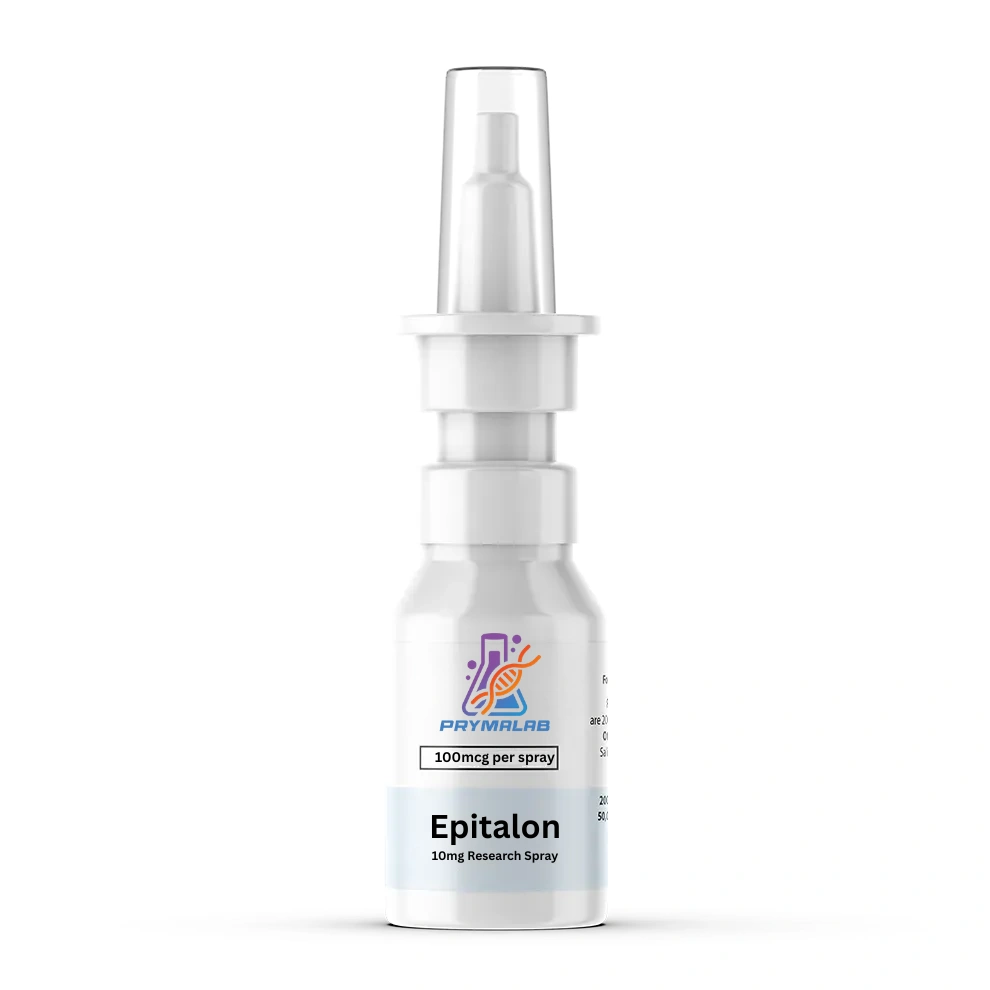
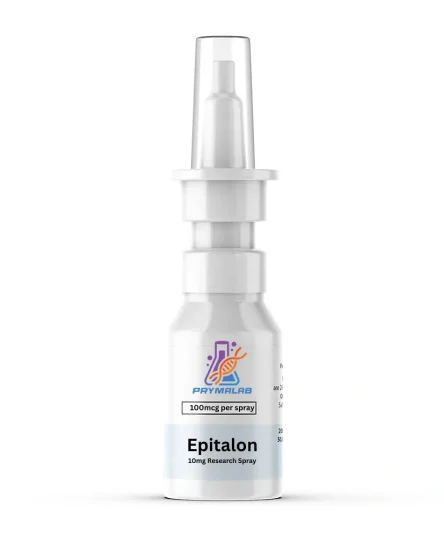
Epitalon Nasal Spray 10mg
Ala-Glu-Asp-Gly · CAS 307297-39-8 · 390.35 Da
Epitalon nasal spray supplies the tetrapeptide Ala-Glu-Asp-Gly, CAS 307297-39-8, molecular weight 390.35, as a metered aqueous solution. Of the sixteen compounds in the Khavinson bioregulator range this is the most searched, and its terminal glycine makes it the most exposed to enzymatic attack.
Specification Table
| Property | Value |
|---|---|
| Compound | Epitalon, also written Epithalon |
| CAS number | 307297-39-8 |
| Molecular formula | C14H22N4O9 |
| Molecular weight | 390.35 g/mol |
| Residue count | 4 |
| Sequence designation | AEDG |
| Three-letter sequence | Ala-Glu-Asp-Gly |
| Truncation relative | Chonluten (Glu-Asp-Gly) is this compound minus its alanine |
| Carboxy terminus | Glycine, the least sterically hindered residue available |
| Net charge at neutral pH | Negative. Two acidic residues, no basic residue |
| Chromophore | None. Concentration cannot be determined by 280 nm absorbance |
| Oxidation-prone residues | None |
| Originating programme | St Petersburg Institute of Bioregulation and Gerontology |
| Proposed mechanism in the literature | Sequence-specific interaction with DNA, modulating tissue-associated gene expression |
| Mechanism status | Hypothesis. Not independently established outside the originating programme |
| Format | Metered nasal spray, solution state |
| Physical state | Aqueous solution, supplied ready to use |
| Purity | Per lot-specific certificate of analysis |
| Storage | 2-8°C, protected from light. Do not freeze |
| Regulatory status | No approved human or veterinary formulation in any jurisdiction |
Why Does the Glycine Terminus Matter in Epitalon Nasal Spray?
Four compounds in the bioregulator range end in different residues, and this one drew the least protected of them.
Glycine has no side chain at all, only a hydrogen atom on the alpha carbon. That makes it the smallest and least sterically hindered residue available.
Carboxypeptidases work inward from the carboxy end and need to fit that terminal residue into an active site. A glycine slides in without obstruction.
Compare that with Cortagen and Prostamax, which both end in proline. A proline ring is poorly accommodated by the same enzymes and obstructs an entire class of them.
So within one structural family sharing three of four residues, this compound sits at the vulnerable end of the spectrum and those two sit at the protected end.
That difference is worth more than a footnote for epitalon nasal spray, because a spray keeps the molecule in water where any contaminating enzyme activity can act.
Nobody appears to have measured comparative half-lives across this family. That is a straightforward experiment that the compounds are cheap enough to make trivial.
For a buyer the practical consequence is that sterility and clean handling matter more here than for the proline-terminating members of the same range.
What Truncation Risk Applies to This Compound?
Mapping the sequences across the bioregulator family surfaces a specific quality question for this molecule.
Chonluten is Glu-Asp-Gly. Remove the alanine from this compound and Chonluten is exactly what remains.
Solid-phase synthesis builds a chain from the carboxy terminus backwards, so alanine is the last residue added here. A failed final coupling delivers Chonluten rather than Epitalon.
Both compounds are sold in this catalogue, which means a supplier running them on shared equipment has a carryover route in addition to a synthesis route.
The masses differ by roughly 71 daltons, the residue mass of alanine, putting Chonluten near 319.3 against 390.35 here. Any mass spectrometer resolves that comfortably.
Chromatographically the two separate as well, since adding a hydrophobic alanine shifts retention, so a well-run reversed-phase method shows distinct peaks.
The question to put to a supplier is narrow and answerable. Does the chromatogram show anything at the Chonluten retention time, and does the mass spectrum show a species near 319.3.
This is the single most useful certificate question for this compound. It costs a vendor one line to answer.
How Does the Spray Format Change the Chemistry?
A lyophilized vial and epitalon nasal spray hold the same molecule under conditions that differ in one important respect.
Dry powder is chemically quiet. With no cysteine, methionine, tryptophan or asparagine-glycine motif, a sealed dry solid at refrigerator temperature is close to inert.
Water changes that. Peptide bonds hydrolyse slowly in aqueous solution, and the aspartate residue at position three is a known weak point, since Asp-Gly sequences are prone to backbone cleavage and to isomerisation.
This compound has exactly that motif. Aspartate followed by glycine at positions three and four is one of the more labile arrangements in peptide chemistry.
The isomerisation product carries the same mass as the parent, so mass spectrometry cannot see it at all, and chromatographic separation is not guaranteed under a routine gradient.
That makes time in solution the variable to control rather than a detail, and it is the strongest argument for the vial format where an experiment needs a defined starting material.
The spray removes the reconstitution arithmetic and delivers a metered volume, which is the offsetting convenience.
Neither format escapes the chemistry. What differs is who controls the clock and whether the elapsed time is known.
How Does 390 Daltons Affect Intranasal Delivery?
Molecular weight is the single most reliable predictor of transnasal transport, and epitalon nasal spray sits favourably on it.
Published nasal absorption work shows a steep decline with increasing size, with the practical transition around 1,000 daltons where paracellular passage becomes inefficient.
At 390.35 daltons this compound sits well below that transition, comparable to GHK-Cu at roughly 404 and larger only than glutathione at 307.32 among the sprays here.
Being small is necessary without being sufficient. Two acidic residues and no basic residue leave the molecule anionic at physiological pH, and a negatively charged mucosal surface works against passage of an anion.
Published intranasal pharmacokinetic data for this compound specifically is not established. The Russian literature that exists has generally used parenteral or lingual routes.
Extrapolating from a parenteral figure requires an absorption fraction that has not been measured here, so the conversion cannot be made honestly.
What can be said is that molecular size is not the limiting factor, which distinguishes it from the larger peptides delivered by this route.
What Epitalon Spray Dosage Figures Are Published?
Each figure below comes from a published study, in whichever species and by whichever route that study used.
Rodent work from the originating programme occupies the microgram per kilogram band by parenteral routes, in line with the rest of the Khavinson range.
The Russian clinical record describes courses of ten to twenty days at tens to low hundreds of micrograms, given as discrete blocks rather than continuous exposure.
Lingual and sublingual preparations appear in that literature, and figures from those routes are not comparable with parenteral amounts without an absorption argument.
The peer-reviewed record establishes no intranasal figure for this compound at all. Saying that plainly beats filling the gap with a converted number.
No receptor affinity is on record anywhere for this molecule, so no concentration can be defended from first principles and wide ranging is a requirement rather than a preference.
Interspecies conversion needs allometric scaling by body surface area rather than body-weight arithmetic.
What Research Endpoints Are on Record?
The published record for this compound is the largest in the bioregulator family, which is a relative statement rather than a strong one.
Work from the originating programme reports observations in aged rodent models with histological assessment and markers of tissue-associated gene expression.
Cell-culture work across the family reports chromatin decondensation, advanced in support of the DNA-binding hypothesis rather than of any specific tissue claim.
The telomerase literature attached to this compound is frequently cited well beyond what its cell-culture setting supports, and the primary papers are worth reading rather than the summaries.
No receptor has been identified and no binding constant appears anywhere in the record, which is the central gap in the mechanistic account.
No well-powered independent Western clinical trial exists for this compound or any other in the range.
Settled chemistry, a modest research record and an unresolved mechanism. Keeping those three apart is what makes a statement about this compound defensible.
Why Is the Spelling Split Worth Noting?
Two spellings of this compound circulate in roughly equal measure, and the split has practical consequences for anyone searching the literature.
Epitalon and Epithalon both refer to the same tetrapeptide, Ala-Glu-Asp-Gly, under CAS 307297-39-8. Neither is more correct than the other.
The variation comes from transliteration out of Russian, where the originating literature was published, and no standardising body has ever settled it.
A literature search using one spelling misses a substantial share of the record. That is a real problem given how much of that record is Russian-language.
The related name Epithalamin refers to something different, a pineal peptide extract rather than a defined synthetic tetrapeptide, and conflating the two is a common error.
That extract was the starting material from which this sequence was identified. So the two are historically linked but chemically distinct.
A supplier certificate should name the compound by sequence rather than by trade name, since AEDG is unambiguous where the trade names are not.
When citing published work, checking whether the study used the defined tetrapeptide or the extract is worth the thirty seconds it takes.
How Should the Spray Be Stored and Recorded?
Storage advice for epitalon nasal spray follows from hydrolysis rather than oxidation, which narrows the recommendations.
Hold the bottle between 2 and 8 degrees Celsius, protected from light, and never freeze a solution-state product.
There is no thiol, no thioether and no aromatic residue, so the oxidation and photodegradation routes that trouble other sprays in this range do not apply.
What does apply is the Asp-Gly backbone lability described above, which is temperature and pH dependent and accelerates under alkaline conditions.
A periodic pH check on an opened bottle is therefore worth running, since a solution drifting upward degrades faster at exactly the bond that matters.
Because the isomerisation product is mass-identical to the parent, elapsed time in solution is the only practical proxy for degradation available without a dedicated method.
Note the lot, the stated concentration, when the bottle was first opened, the storage temperature, and how many actuations each experiment consumed.
For a study running more than a few weeks, re-measuring rather than assuming is the defensible approach with this molecule.
Published Literature
Selected references. This literature originates almost entirely from one research programme.
- (‘Khavinson VK, Bondarev IE, Butyugov AA. Epithalon peptide induces telomerase activity and telomere elongation in human somatic cells. Bull Exp Biol Med. 2003;135(6):590-592.’, ‘https://doi.org/10.1023/A:1025493705728’)
- (‘Khavinson VK, Malinin VV. Gerontological Aspects of Genome Peptide Regulation. Basel: Karger; 2005.’, ‘https://doi.org/10.1159/isbn.978-3-318-01193-6’)
- (‘Anisimov VN, Khavinson VK. Peptide bioregulation of aging. Biogerontology. 2010;11(2):139-149.’, ‘https://doi.org/10.1007/s10522-009-9249-8’)
- (‘Geiger T, Clarke S. Deamidation, isomerization, and racemization at asparaginyl and aspartyl residues in peptides. J Biol Chem. 1987;262(2):785-794.’, ‘https://doi.org/10.1016/S0021-9258(19)75855-4’)
Frequently Asked Questions
What is Epitalon nasal spray?
A metered aqueous solution of the tetrapeptide Ala-Glu-Asp-Gly, CAS 307297-39-8, molecular weight 390.35. Laboratory research use only. No jurisdiction has approved this compound for any purpose.
Why does the glycine terminus matter?
Because glycine has no side chain, only a hydrogen on the alpha carbon, making it the least sterically hindered residue available. Carboxypeptidases working inward from that end meet no obstruction.
How does that compare with the rest of the family?
Cortagen and Prostamax both end in proline, whose ring is poorly accommodated by the same enzymes. Within one family sharing three of four residues, this compound sits at the vulnerable end and those two at the protected end.
What truncation risk applies?
Chonluten is Glu-Asp-Gly, which is this compound minus its alanine. Since synthesis builds backwards from the carboxy terminus, a failed final coupling delivers Chonluten rather than Epitalon.
How is that checked?
The masses differ by roughly 71 daltons, putting Chonluten near 319.3 against 390.35 here. Ask whether the chromatogram shows anything at the Chonluten retention time or a species near 319.3.
What changes in a solution-state format?
Hydrolysis becomes live. The aspartate at position three followed by glycine at position four is an Asp-Gly motif, one of the more labile arrangements in peptide chemistry, prone to backbone cleavage and isomerisation.
Can that degradation be detected?
Not easily. The isomerisation product carries the same mass as the parent, so mass spectrometry cannot see it, and chromatographic separation is not guaranteed under a routine gradient. Elapsed time is the practical proxy.
How does its size affect absorption?
At 390.35 daltons it sits well below the roughly 1,000 dalton transition where paracellular nasal transport becomes inefficient. Size is not the limiting factor, though net negative charge works against passage.
What dosage figures are published?
Rodent work in the microgram per kilogram band by parenteral routes, and a Russian clinical record describing ten to twenty day courses at tens to low hundreds of micrograms. Intranasal figures are not established.
What research endpoints are on record?
Aged rodent observations with histology and gene-expression markers, plus family-wide cell-culture work on chromatin decondensation. The telomerase literature is frequently cited beyond what its cell-culture setting supports.
How should the bottle be stored?
Between 2 and 8 degrees Celsius, protected from light, never frozen. A periodic pH check is worthwhile since the Asp-Gly lability accelerates under alkaline conditions.
Compliance Statement
Epitalon nasal spray is sold exclusively for laboratory research use. It is not a drug, food, or cosmetic product, and it is not a dietary product of any kind. It is not approved by the FDA or any comparable authority for human or veterinary use, its proposed mechanism has not been independently established, intranasal pharmacokinetic data for this compound is not established, and amounts cited are figures from published studies in the species and by the route those studies used. This product is not intended to diagnose, treat, cure, or prevent any disease. It must not be given to humans or animals. Purchase is restricted to qualified researchers and institutions operating within applicable laws. All handling is the responsibility of the purchasing laboratory.
Other formats of Epitalon
Epitalon is also stocked as Epitalon 10mg, Epitalon 50mg and Epithalon 15mg preloaded 3ml pen. Each listing states its own quantity and concentration, and the pen and vial comparison explains what changes between formats.


11 reviews for Epitalon 10mg Nasal Spray